
“Why am I this tired? It’s two in the afternoon…”
“I slept fine. I ate lunch. And now I can barely keep my eyes open…”
If that’s the conversation in your head most afternoons, I want you to hear something first: You’re not lazy, and this isn’t a discipline problem. You’re on a rollercoaster: You just never noticed buying the ticket.
You’re not just tired: You’re falling.
Here’s what actually happens after a typical lunch. The sandwich, the pasta, the “quick something” from the bakery: they’re heavy in fast carbohydrates, so your blood sugar climbs fast. Your body answers with insulin to bring it back down. And when the drop comes, it often doesn’t stop at “normal.” It dips below where you started.
That dip is the crash.
This isn’t theory. A study in Nature Metabolism tracked over 1,000 people wearing continuous glucose monitors across thousands of standardized meals (Wyatt 2021). The people whose blood sugar dipped hardest two to three hours after eating got hungrier sooner and ate more for the rest of the day. The dip predicted their appetite better than the spike did.
Read that again: the crash isn’t just stealing your afternoon. It’s ordering your 4pm snack for you.
I know this ride personally: I wrote about the spike-and-crash pattern years ago in my piece on sugar sources, back when my own afternoons were a write-off. The fix wasn’t more coffee and it definitely wasn’t more willpower. It was changing what the ride looks like.
The honest part: some of the dip is built in
I’d be lying if I told you lunch is the whole story, and this blog doesn’t do that.
Sleep researchers have known for decades that there’s a natural early-afternoon slump wired into the human clock, the “post-lunch dip,” and it shows up even in studies that weren’t about food at all (Horne 1991, Askaripoor 2019). Your body was always going to ease off around 2pm.
So here’s the fair frame: the dip is partly your body clock. And lunch decides whether it’s a gentle slope or a jump off a cliff. (metaphorically speaking!)
And if you’re past 50, there’s one more piece of honest context. Estrogen helps your body respond to insulin, and as it falls away, blood sugar handling gets less forgiving (De Paoli 2021). The same lunch that was fine at 35 can hit differently now. That’s chemistry, not character.
One more truth, because you deserve the real picture: a steadier lunch won’t make you sharper by 3pm. In one trial in schoolchildren, a higher- versus lower-GI lunch made no reliable difference to afternoon performance (Jansen 2020). What a steadier lunch gives you instead: fewer freefalls and less of that clawing 4pm hunger. That alone changes an afternoon.
How to get off the rollercoaster
You don’t need a new diet. You need a flatter track. Three moves, all of them small:
1. Change the boarding order.
Same food, different sequence: protein and vegetables first, the carbs last. In a small trial, people who ate this way cut their post-meal glucose peak by more than 40 percent compared to eating carbs first (Shukla 2019). It was a small study, so treat it as a strong lead rather than a law. But it costs you nothing to try, today, with the lunch you already have. Chicken and salad before the bread. Eggs before the toast.
2. Put fiber on the track.
Viscous fiber slows the whole ride down. A meta-analysis on psyllium found it improved blood sugar control most in the people whose blood sugar was already wobbly, with a smaller effect in people running steady (Gibb 2015). In food terms: vegetables, oats, seeds, legumes. Not exotic. Just present, at lunch, most days.
3. Go sweet without the spike and crash.
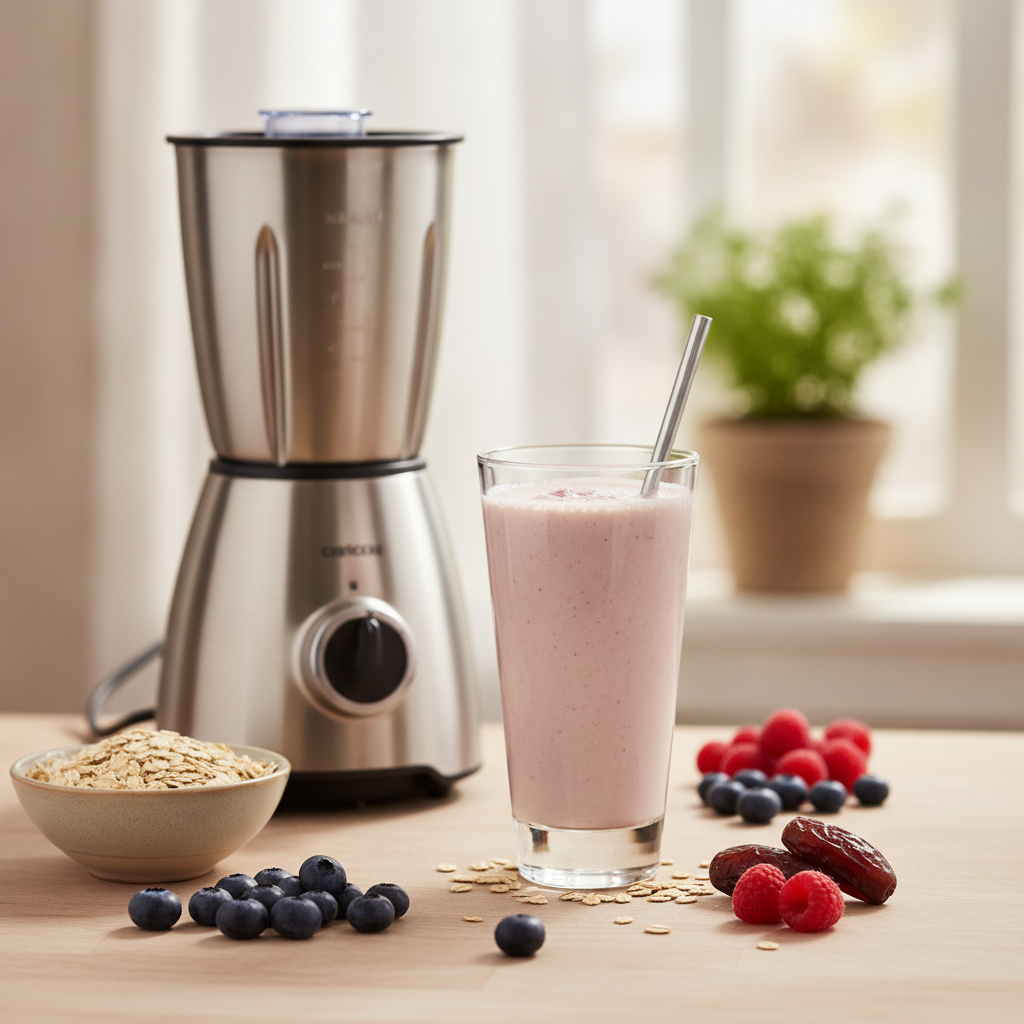
If your afternoon needs something sweet, pick a sweetener that climbs gently. Dates test as low glycemic index, roughly 46 to 56 across five varieties, in both healthy people and people with diabetes (Alkaabi 2011). It’s why they’re one of my favorite snacks and my smoothie sweetener (IF your blender can handle them!). Low GI is not a license for volume, though. Just don’t go overboard with the dates, I keep them at 5 to 6 at a time MAX! As always, the choice is yours…
What a flat-track lunch looks like
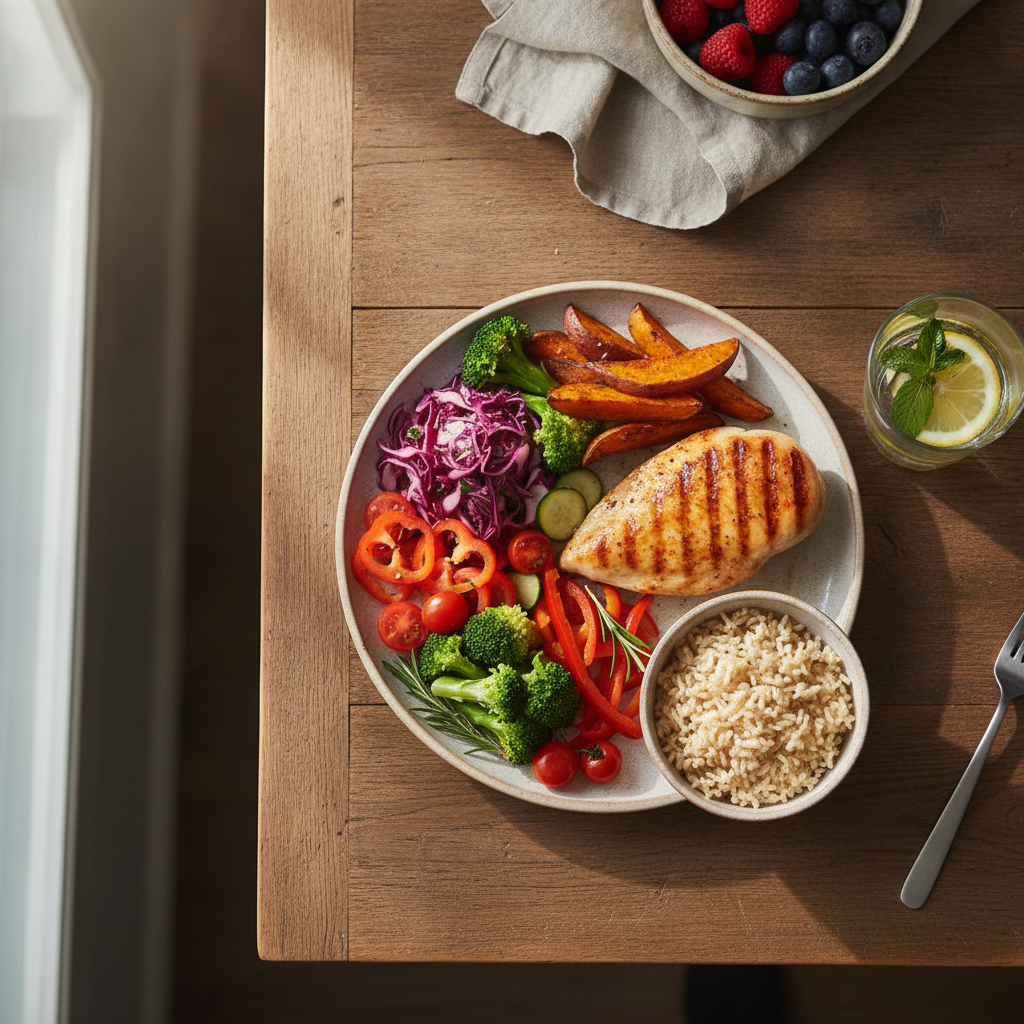
Nothing fancy. A palm of protein (chicken, fish, eggs, Greek yogurt), a real pile of vegetables, then your carbs, ideally the slower kind. Eaten in that order. Optional: A big glass of water. Done in fifteen minutes.
And on the days when there’s no time to build a plate at all? This is exactly why my go-to lunch is often a smoothie built for steadiness: protein, fiber, healthy fats, dates for sweetness. The whole logic of this article is in one glass, couple minutes of work.
The part worth remembering
Your 2pm crash was never a verdict on you. It’s a ride with a predictable shape: part body clock, part blood sugar, and the blood sugar part answers to what’s on your plate. Change the order, add the fiber, sweeten gently, and the cliff becomes a slope you barely notice.
You don’t have to white-knuckle your afternoons. All it could take is redesigning one meal.
If you want the steady-energy version of eating handed to you instead of pieced together, start here. That’s what this whole site is for.
Get my first 3 smoothie mornings, free
Three dessert-style smoothies that work with your body after 50. Under seven minutes each. Tell me where to send them.
Free. Unsubscribe anytime, no spam.